
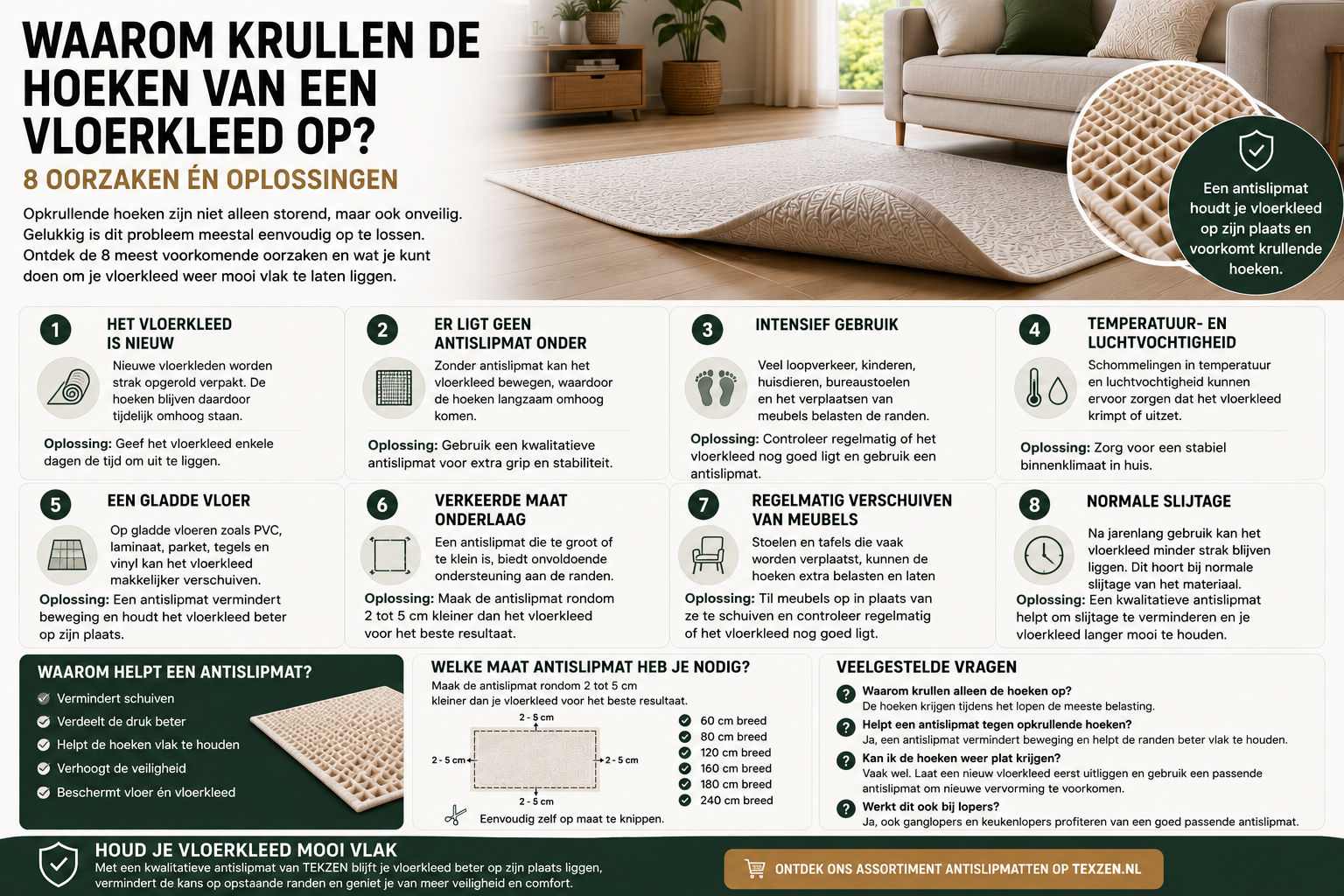
Curling corners are not only annoying, but also unsafe
You've just bought a beautiful rug, but after a while, the corners start to curl up. This not only looks messy but also increases the chance of someone tripping over the rug.
Fortunately, this is a common problem that, in most cases, is easy to solve. In this blog, you'll discover why rug corners curl up and what you can do to make your rug lie flat again.
1. The rug is new
Many new rugs are tightly rolled for packaging. As a result, the corners may temporarily stay curled up after unrolling.
Solution
Give the rug a few days to settle. In many cases, the curled corners will disappear on their own.
2. There is no non-slip mat underneath
A rug that can move is constantly subjected to small forces during walking. This can cause the corners to gradually lift.
Solution
Use a quality non-slip mat. This will keep the rug better in place and reduce the chance of curling corners.
3. Intensive use
In heavily trafficked areas such as the living room, kitchen, or hallway, the edges of a rug are constantly stressed.
Especially:
- children;
- pets;
- desk chairs;
- heavy foot traffic;
can cause the corners to lift faster.
4. Temperature and humidity differences
Some materials react to changes in temperature and humidity. This can cause a rug to shrink or expand slightly.
A stable indoor climate helps to limit this.
5. A smooth floor
On PVC, laminate, parquet, tiles, and vinyl, a rug can slide more easily. This movement puts more stress on the corners.
A non-slip mat significantly reduces this movement.
6. Incorrect underlay size
If a non-slip mat is too large or too small, the rug will not be optimally supported.
For the best result, make the non-slip mat about 2 to 5 centimeters smaller all around than the rug.
7. Regular shifting of furniture
Is a chair or coffee table often moved? This can put extra stress on the corners of the rug.
Therefore, regularly check if the rug is still lying neatly.
8. Normal wear and tear
After years of use, some rugs may not lie as flat. This is part of the normal wear and tear of the material.
A good non-slip mat helps to limit this wear as much as possible.
Why does a non-slip mat help?
A quality non-slip mat:
- reduces slipping;
- distributes pressure better;
- helps keep the corners flat;
- increases safety;
- protects both floor and rug.
As a result, a rug stays beautiful longer.
What size non-slip mat do you need?
At TEKZEN, non-slip mats are available in:
Choose a size that matches your rug and easily cut the mat to size if necessary.
Frequently asked questions
Why do only the corners curl up?
The corners receive the most stress during walking. As a result, they deform more quickly than the center of the rug.
Does a non-slip mat help against curling corners?
Yes. A non-slip mat reduces rug movement and helps keep the edges flatter.
Can I get the corners flat again?
Often, yes. Let a new rug settle first and use a suitable non-slip mat to help prevent new deformation.
Does this also work for runners?
Yes. Hall runners and kitchen runners also benefit from a well-fitting non-slip mat.
Keep your rug beautifully flat with a non-slip mat from TEKZEN
Curling corners are a common problem, but fortunately easy to limit. With a quality non-slip mat, your rug will stay better in place, the chance of raised edges is reduced, and you will enjoy more safety and comfort. View TEKZEN's range of non-slip mats and easily choose the right size for your rug or runner.
Also read our other blogs about non-slip mats
Want to know more about choosing, using, and maintaining non-slip mats? Check out our other helpful guides:
- When should you replace a non-slip mat? 7 clear signs
- How to prevent a rug from sliding? 10 practical solutions
- How to clean a non-slip mat? This is how it stays optimally functional
- Non-slip mat or double-sided tape: what is the best choice?
- Which non-slip mat is suitable for vinyl?
- Which non-slip mat is suitable for tiled floors?
- Which non-slip mat is suitable for parquet?
- Which non-slip mat is suitable for laminate?
- Does a non-slip mat work on underfloor heating? Everything you need to know
- Which non-slip mat is suitable for a PVC floor?
- The most common runner dimensions in the Netherlands
- The most common rug sizes in the Netherlands
- Can you cut a non-slip mat to size yourself? Everything you need to know
- Non-slip mat or underlay: what is the difference?
- Why does a rug slide? 7 causes and the best solution
- What size non-slip mat do I need? The complete buying guide