
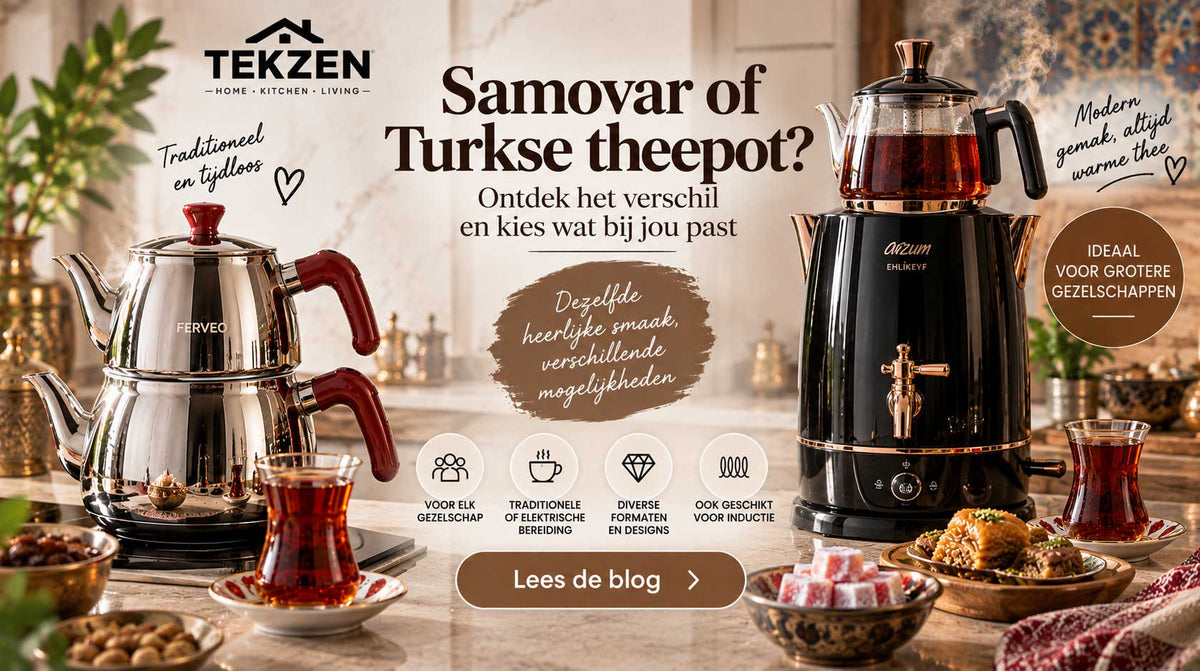
Anyone who enjoys drinking Turkish tea will quickly come across various ways to prepare it. Two well-known options are the samovar and the Turkish teapot, or çaydanlık.
At first glance, they look similar. With both, you can keep strong tea and hot water separate and determine the desired strength yourself while pouring.
However, there are clear differences in usage, capacity, and the heating method.
When do you choose a traditional Turkish teapot and when is a samovar more practical? We have listed the differences.
What is a Turkish teapot?
A traditional Turkish teapot is also called a çaydanlık.
The system consists of two pots placed on top of each other. The large bottom pot contains hot water, and strong tea is steeped in the smaller top pot.
When pouring, you first put an amount of tea concentrate into the glass. Then, you top it off with hot water from the bottom pot.
This way, everyone can decide for themselves how strong the tea should be.
TEKZEN currently carries various double Turkish teapots from Ferveo in materials including stainless steel and glass. The collection contains a variety of sizes, and many of these models are suitable for induction.
What is a samovar?
A samovar is a system that allows you to heat and keep a larger quantity of water hot while simultaneously preparing tea.
You may also come across the spelling semaver.
Modern samovars are often electric. Instead of placing the pot directly on a stovetop, the device has its own heating element.
Within the current TEKZEN range, you will find, for example, the Arzum Ehlikeyf Samovar. This electric Turkish tea machine has a capacity of 3.5 + 1.2 liters, a power output of 2200 watts, and an LED indicator. It is available in black and white.
What do a samovar and çaydanlık have in common?
The most important principle is similar.
With both systems, you can keep concentrated tea and hot water separate. As a result, you do not have to make one fixed tea strength in advance.
Someone who wants strong tea uses relatively more tea concentrate. For lighter tea, you use more hot water.
This makes both systems particularly suitable when multiple people are drinking tea together.
The biggest difference: capacity
An important difference is the amount of tea and hot water you can have available.
A traditional çaydanlık can be quite compact. For instance, the Ferveo Seyma at TEKZEN has a capacity of 0.7 + 1.5 liters. Larger versions also exist: the Ferveo Noya and Beyza, for example, are available with a combination of 1.0 + 3.0 liters.
The Arzum Ehlikeyf Samovar has a water section of 3.5 liters and a separate teapot of 1.2 liters.
A samovar therefore becomes particularly interesting when you regularly want to prepare larger quantities of tea or want hot water available for a longer period of time.
Difference in heating
The heat source also differs.
A traditional çaydanlık is generally placed on a stovetop. If you use induction at home, the chosen teapot must be specifically suitable for it.
TEKZEN has various induction-suitable Ferveo models for this, including Seyma, Ayda, Alima, Mina, Nora, Velda, Yasmina and Noya.
An electric samovar, on the other hand, has its own heating element. Therefore, you do not need a stovetop to heat the water electrically.
When do you choose a çaydanlık?
A çaydanlık is interesting if you enjoy the traditional way of making Turkish tea.
You have two separate pots, decide for yourself how much water you heat, and can choose from various materials and sizes.
Additionally, a smaller çaydanlık usually takes up less space than a large electric samovar.
For daily use by a few people, a traditional Turkish teapot can therefore be a practical choice.
When is a samovar useful?
A samovar truly comes into its own when a lot of tea is being drunk.
Think, for example, of a large family, family visits, a birthday, or a long breakfast where several glasses of tea are poured over a longer period.
With a larger water reservoir, you don't have to refill the water as often.
An electric version also has the advantage that you do not need an available cooking zone.
Samovar for Turkish tea
A samovar fits perfectly with the way Turkish tea is consumed.
You make strong tea and use the hot water to bring each glass individually to the desired strength.
That is the same basic principle we know from the çaydanlık.
The difference is therefore not so much in the idea behind the tea, but primarily in the design, capacity, and heating method.
Samovar or electric kettle?
A samovar should also not be confused with a regular electric kettle.
An electric kettle is primarily intended to heat water. A samovar combines a larger water section with a separate section for tea.
The Arzum Ehlikeyf within the TEKZEN range is therefore offered as a Turkish tea machine with a capacity of 3.5 + 1.2 liters.
For just a cup of hot water, an electric kettle is simpler. For multiple rounds of Turkish tea, a samovar offers a different level of convenience.
And an electric Turkish teapot?
There is another intermediate solution.
An electric Turkish teapot also uses two sections but is more compact than a large samovar.
For example, TEKZEN currently sells the Arzum Tea Clock with a capacity of 1.7 + 1.0 liters, 2200 watts of power, and a 360° base.
You can therefore roughly view the range as three possibilities: a traditional çaydanlık for use on the stovetop, an electric double teapot for more convenience, and a larger electric samovar for generous quantities.
Which one fits your household?
Look primarily at how much tea you normally make.
If you drink a few glasses daily with one or two people, a compact çaydanlık can be more than enough.
If you regularly make tea for a family or guests, you might consider a larger double teapot.
If you want to have a lot of water available and want to prepare and serve tea electrically, a samovar becomes more interesting.
Also, consider the space available in your kitchen and, for a traditional teapot, the heat source you intend to use it on.
Samovar and Turkish teapots at TEKZEN
So, there is no complicated difference in the way you determine the strength of Turkish tea. With both a çaydanlık and a samovar, you work with strong tea and hot water.
The main difference lies in the appliance itself.
A çaydanlık is the traditional double teapot and is available in different sizes, materials, and induction-suitable versions. An electric samovar, on the other hand, offers a larger capacity and its own electric heat source.
Within the current collection of Teapots at TEKZEN, you will find both solutions: traditional Turkish teapots, electric teapots, and the Arzum Ehlikeyf Samovar.