
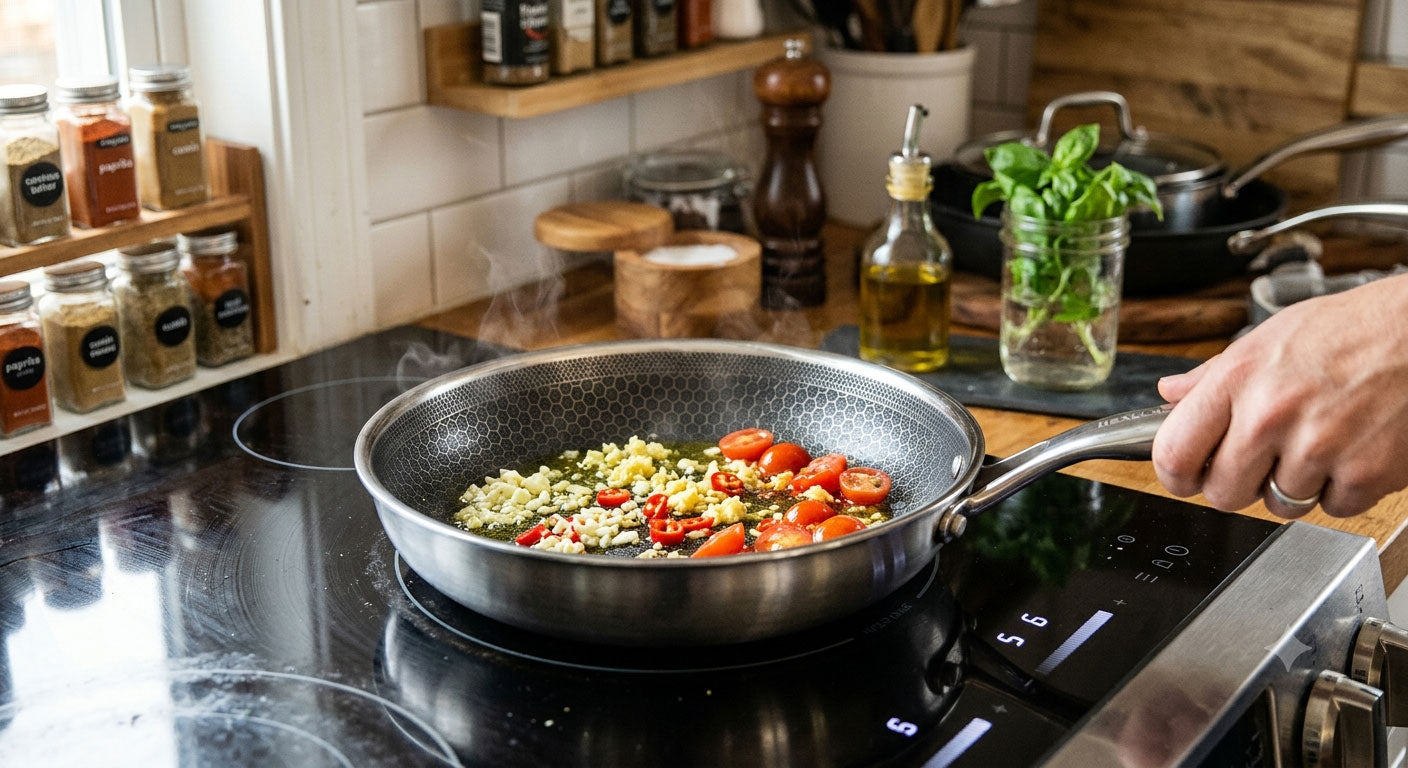
You are looking for a new pan and see both stainless steel pans and honeycomb pans. That sounds like a choice between two materials, but it is not that simple. Stainless steel describes the material; honeycomb refers to the structure of the cooking surface. A pan can therefore be made of stainless steel and also have a honeycomb pattern.
By making that distinction, you can compare more effectively. Look at the stainless steel pans and honeycomb pans for the features of the version you want to use, rather than just the name.
What does the stainless steel designation tell you?
Stainless steel stands for rust-resistant steel. You will come across it in frying pans, saucepans and casserole dishes, among others. The designation does not automatically tell you how the inside is constructed, what base construction the pan has, or what the allowed oven temperature is. For that, you need the individual product specifications.
For example, compare the Cheffinger 28 cm stainless steel frying pan in silver with the Cheffinger 28 cm honeycomb frying pan. They have the same stated diameter and are both offered as stainless steel, but the honeycomb version has a specifically described cooking surface.
What is a honeycomb pan?
You recognize a honeycomb pan by the pattern on the cooking surface. In the Cheffinger version mentioned, this is described as a honeycomb non-stick structure. The construction, finish and instructions for use may vary by series.
Therefore, do not assume that every honeycomb pan has the same coating, temperature resistance or maintenance method. A pattern itself also does not say that a pan can never be scratched or that you should use it without cooking fat. The instructions of the specific model remain the starting point.
This is how you compare both versions
- Your dishes: are you looking for a wide frying pan, a deeper casserole dish, or a wok pan for multiple ingredients?
- The cooking surface: check how the inside is described and whether a coating is mentioned.
- The size: in addition to the diameter, also compare the usable base and the height.
- The handle: look at the shape, the material and the instructions for oven use.
- The maintenance: follow the instructions for cleaning, preheating and suitable cookware.
Which pan do you choose for induction?
All pans sold by TEKZEN are suitable for induction. Do match the base size to the cooking zones and the instructions of your cooktop. A larger top rim does not automatically mean that the base has the same diameter.
Then choose based on how you usually cook. A pan that fits comfortably on your cooktop and offers enough space for your portions is more usable than a larger version that you can hardly handle. Also read the size guide for frying pans of 20, 24, 28 and 32 cm.
Tailor maintenance to the version
Let the pan cool down before you clean it and use the cleaning method prescribed by the manufacturer. Check before using metal cookware whether that is allowed for your model. Also do not automatically season a stainless steel pan: for a version with a coating, a different treatment may apply.
Do you want a complete set or try one pan first? Compare the Cheffinger frying pans and then choose by size and version. The difference lies in the overall design of the pan, not just in the words stainless steel or honeycomb.